Imagine waking up to find your content removed, your page taken down, or worse, an official notice claiming you have violated copyright law. No warning, no explanation, and only your content is gone. Sounds stressful, right?
This is exactly why understanding how DMCA takedown notices work is not just helpful but necessary for anyone creating or managing content online.
Many website owners, bloggers, and online creators find DMCA notices intimidating at first. They sound legal, serious, and final. But here’s the truth: not every takedown notice is justified, and not every claim means you are at fault. Sometimes, it is a genuine copyright issue. Other times, it’s a misunderstanding or even misuse of the system.
That’s why you need clarity, not panic. Knowing how the process actually works gives you control over the situation. It helps you respond the right way, protect your content, and even challenge unfair claims when necessary.
So in this blog, we will walk you through everything in a simple, non-complex way so you are not caught off guard and know exactly what to do if a DMCA notice ever lands in your inbox.
What Is a DMCA Takedown?
A DMCA takedown is a legal request used to remove content from the internet when someone believes their copyrighted work is being used without permission. DMCA stands for Digital Millennium Copyright Act, a U.S. law that protects original content like articles, images, videos, music, and more.
You create something original and someone copies or uses it without your consent, you can send a DMCA takedown notice to the platform (like Google, YouTube, or a hosting provider) asking them to remove that content.
How DMCA Takedown Notices Work? (Step-by-Step Process)
Understanding the DMCA process becomes easier when you break it down.
Here’s how a typical DMCA takedown notice works:

Step 1: Someone finds their content being used.
It all starts with a discovery. Maybe you’re browsing the web and stumble across your article, photo, or video being used on someone else’s site without any credit, permission, or licensing agreement. This is the moment the DMCA process begins.
Step 2: They send a DMCA takedown notice.
Your next move is filing a formal complaint with the platform or hosting provider where the stolen content lives. But this isn’t just a casual email; your notice needs to include some specific things to be legally valid:
Missing any of these can cause the platform to reject or delay your request.
Step 3: Your Normal Hosting providers receive the notice
Your hosting company receives the complaint in their inbox. Most of the normal hosting providers get nervous at this point and want to act fast to protect themselves.
Step 4: Your Host takes immediate action
Without even informing you, your hosting provider removes your content or takes your entire site offline. They do this to avoid any legal trouble on their end.
Step 5: You get an Email
After your site is already down, you receive an email from your hosting provider explaining what happened. By this time, the damage is already done.
Step 6: Counter-notice (If you fight back)
You can file a counter-notice whenever you sincerely believe in good faith that your work was improperly removed; it’s not limited to fair use situations.
It’s possible that you have a license, that you actually own the rights, or that the claim was just submitted incorrectly. The platform receives your counter-notice and must forward it to the initial complainant. If the content infringes the local laws, then it would be taken down, followed by an entire audit done by the DMCA hosting provider.
It’s important to realize that filing a fraudulent counter-notice is deemed fraud under the DMCA; therefore, you should only do so if you are certain of your stance.
Step 7: Your site stays down during this period
While your counter notice is being reviewed, your site remains offline. You keep losing traffic and revenue every single day.
Step 8: Final Outcome
After the platform forwards your counter-notice, the original complainant has 10 to 14 days to file a lawsuit in federal court if they want to keep the content down. If they don’t take that legal step within the window, the platform is required to restore your content. It’s not automatic, though; the platform makes the call on restoration once that deadline passes without legal action.
Understanding these processes can feel overwhelming, but each step will put you in control. In case you are responding to a takedown or defending your original work with a counter-notice, knowing your rights and obligations under the law is your strongest tool.
Always act in good faith, keep records of every communication, and when in doubt, consult a qualified attorney before taking any action.
The DMCA exists because it protects creators on both sides; use it wisely.
Common Reasons Websites Get DMCA Takedowns
Understanding why takedowns happen is just as important as knowing how to respond to them. Most of the time, they are not random; there is usually a clear pattern.
Here are the most common reasons why you should watch out for them:

Now what’s the bottom line? Most takedowns are avoidable. You just need to verify that you have the right to use any content before publishing it; a little due diligence goes a long way in keeping your website out of trouble.
How to Check If a DMCA Notice Is Legit or Fake?
Not every DMCA notice is genuine. Some are sent by mistake;
others are used as a bullying tactic to remove perfectly legal content. Here is how quickly you can spot the difference:
- Check for Required Legal Elements.
A valid DMCA notice must include:
Missing any of these, then it may not be legally valid.
- Look for the Claimant.
Search for the person or the company sending the notice. Do they exist? Are they actually connected to the content they are claiming? Vague or unverifiable senders are a red flag.
- Verify the Ownership
Check the U.S. Copyright Office database at copyright.gov, do a reverse image search, or look up trademark records. If ownership cannot be confirmed anywhere, be sceptical.
- Always watch for these red flags.
Be cautious always if the notice that you receive:
- Review your Own Content
Did you actually use their work? Is your use covered under fair use? Sometimes notices are sent in bulk, and your content gets caught by mistake.
DMCA notices are not something you take casually, so always refer to a copyright attorney whenever you are in doubt before taking any legal action. A legitimate notice will always have a verifiable sender, a clear claim and proper legal language behind it.
Now lets move to another major aspect.
How to Respond to a DMCA Takedown Notice? (Step-by-Step Guide)
Receiving a DMCA takedown notice can feel alarming, but do not panic.
How you respond matters, and acting carefully and quickly is always in your best interest. So, just follow these steps:
- Step 1: Read the Notice carefully.
Before anything, read the entire notice thoroughly. Understand exactly what content is being claimed, who is claiming it, and what they are asking you to do.
- Step 2: Verify the Notice is Legitimate
Check that the notice contains all required legal elements, claimant identity, copyrighted work description, exact URL, good faith statement, and a signature. If it is missing key information, it may not be legally enforceable.
- Step 3: Identify the Flagged Content
Locate the exact content being disputed on your website or platform. Compare it against the claim and ask yourself honestly:
Your answers to these questions will determine your next move.
- Step 4: Do not Ignore It
This is critical. Ignoring a valid DMCA notice does not make it go away. Platforms and hosting providers are legally required to act on valid notices, and continued inaction can result in your entire account or website being suspended.
- Step 5: Take Down or Dispute (Choose your path)
Here you have two options:
- Step 6: Filing a Counter-Notice
A counter-notice must include the following:
Submit all of this to your platform or provider. They are then required to forward it to the original complainant.
- Step 7: Wait for the Outcome
Once your content notice is submitted, the original complainant has 10 to 14 days to file a lawsuit in federal court if they want the content to stay down. If they do not take legal action within that window, your platform should restore your content.
- Step 8: Keep Records of Everything
Throughout this entire process, document every step. Save copies of the original notice, your responses, any emails exchanged, and timestamps of actions taken. If the situation escalates legally, this paper trail is invaluable.
- Step 9: Consult a Copyright Attorney if Needed
If the claim is complicated and involves major content, or you are unsure of your legal standing, do not guess. A qualified copyright attorney can review your situation and advise you on the strongest course of action.
Always act in trust, and never ignore any notice. You just need to be informed of the right norms of DMCA.
How to File a DMCA Counter-Notification (Fight Back Legally)
In case your content was taken down and you believe the claim was wrong, you have every right to fight back.
A DMCA counter-notification is your legal tool to challenge the takedown and get your content restored. Here is everything you need to know to do it correctly.
What Is a Counter-Notice?
A counter-notification is a formal legal response that tells the platform and the original complainant that you dispute the takedown claim. It triggers a particular legal process under the DMCA that gives the complainant a limited window to take you to court. If they do not, your content must be restored.
When You Should File One
Do not file a counter-notification unless you are confident in your position. Filing a fraudulent counter-notice is considered wrong under federal law. You should always ask yourself:
If you answered all these questions yes, you likely have all the grounds to proceed with the process.
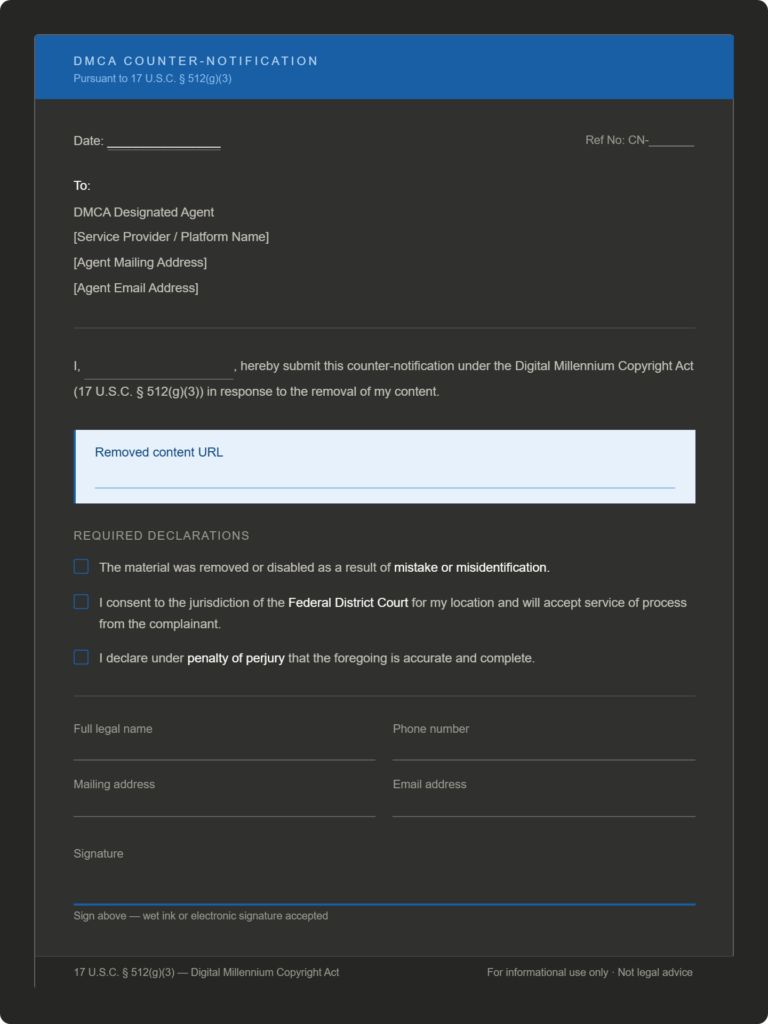
Required Information in a Counter-Notice
By law, a valid DMCA counter-notification must contain all of the following mentioned below:
What Happens After You Submit It?
You have filled your counter-notification, so now what? Here is exactly what happens next, in which order it unfolds.
One important risk: If your counter notice contained any false statements, the complainant can sue you under §512(f) for damages, attorney fees, and costs, even if no lawsuit over the original content was ever filed.
Legal Risks of Fighting a DMCA Notice
Now, let’s talk about what you are actually signing up for.
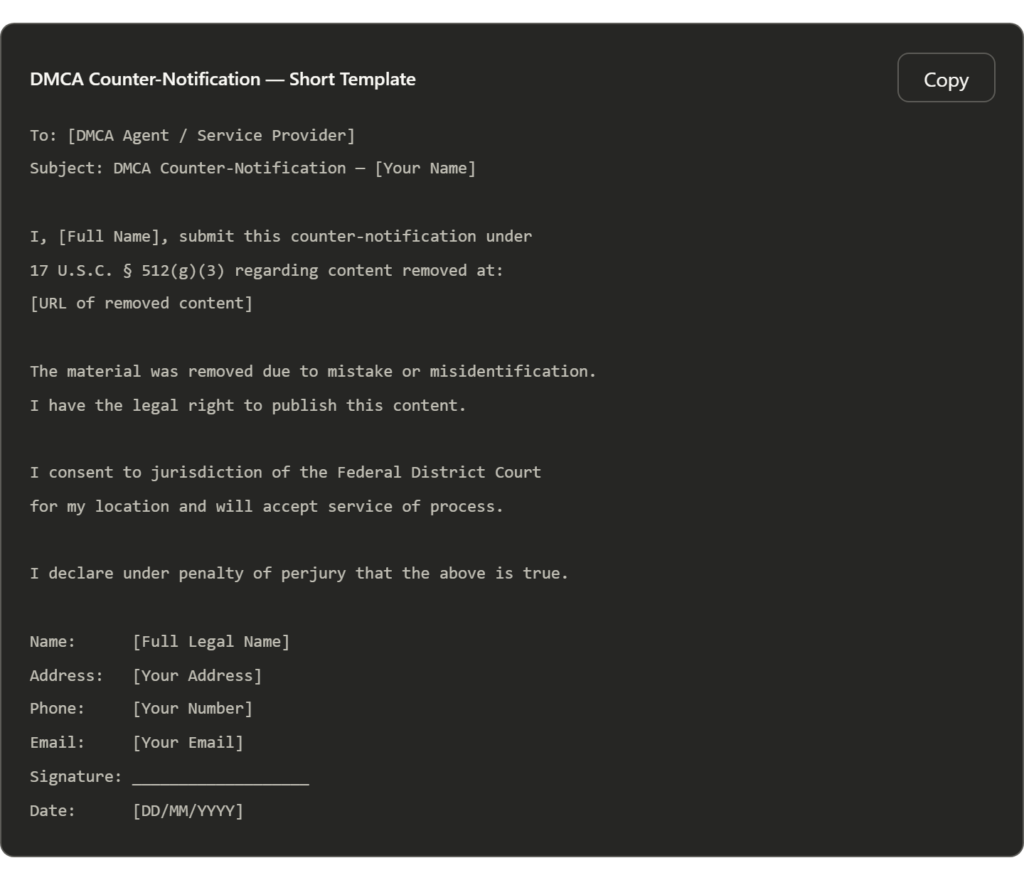
The moment you file a counter-notice, you’re not just clicking any button. You are making a legal declaration under penalty of perjury that you have the right to the content. The provider has 10-14 days to restore it unless the person who has made the claim runs to federal court first.
But what are the real risks?
You are handing them your address. Literally, counter-notices require your contact information, which gets forwarded directly to the person who filed the claim. If they want to sue you, you have just made yourself very easy to find.
You are inviting a federal lawsuit. DMCA disputes live in federal court. That’s not a small claim and not even a simple letter. That has attorneys, discovery, depositions, and bills that will rise no matter you win or lose.
Misrepresentations cut both ways, like if you file a counter-notice in bad faith, meaning you know the content is not yours to use, which is its own legality. The DMCA has the right to take actions against people who abuse the counter-notice process, not just the original applicant.
Using fair means is just like a defence, not a shield. A lot of people file counter-notices, banking on fair use. Fair use is real and valid, but it is also a court that decides situations; it’s not like you declare and win the situation. Everything gets settled in front of a judge, not settled by any provider or platform.
How to Prevent DMCA Takedowns (Pro Tips)
Let’s figure out some pro tips to prevent these DMCA takedowns:
🎵 Music
- Use licensed libraries.
- Platform-native audio is pre-cleared for that platform.
- Licensed music still triggers content ID bots; the license protects you legally, not automatically.
- Mute suspicious background audio before uploading.
📃Licensing
- Get permission in writing, always.
- Keep every receipt, confirmation, and permission thread.
🤖Beating the Bots
- Content ID matches patterns; it doesn’t understand context or fair use.
- Slightly pitch-shift or tempo-adjust licensed audio (verify that your license allows it)
- Keeps clips short for commentary-based content.
✂️Content Strategy
- Transform, don’t just reproduce, because when it comes to parody and criticism, they are found in much stronger legal territory.
- Avoid direct re-uploads entirely, regardless of credits.
🔒Protect your Own Work
- You should register originals with the U.S. Copyright Office.
- Watermark and timestamp all your drafts.
☑️Platform Smarts
- Each of the platforms has different rules, so you should know all of them.
- Use YouTube’s copyright check tool before publishing.
- Dispute all the false claims fast.
Three Major Rules
- Don’t use what you don’t own.
- Document everything you use.
- When in doubt, ignore it.
DMCA Ignored Hosting – What It Is and How It Helps
Have you ever had your content pulled down by some bogus copyright claim? You know how tough the system feels.
DMCA Ignored Hosting is basically what it sounds like, hosting providers that operate out of countries like QloudHost, where U.S. copyright law does not reach, so they don’t act on any of the takedown notices when they have it.
Let’s understand this process in detail.
What Is DMCA Ignored Hosting?
DMCA Ignored Hosting refers to web hosts operating in countries outside the U.S. copyright jurisdiction, places like Russia, Ukraine, Moldova and Panama. At these places, the takedown notices simply don’t carry any legal weight. These providers receive DMCA requests and ignore them, not because they are breaking laws, but because those laws don’t apply to them. Your content stays up, with no automatic removals, and no unnecessary bots pulling your content down overnight.
Now, how does it actually help?
So it is really important to stay realistic. “Ignored” does not mean ‘Illegal-friendly’. These hosts usually operate in countries with lenient copyright enforcement, but you are still responsible for what you publish.
So, while DMCA ignored hosting gives flexibility and protection from abrupt removals, but it should be used wisely, especially if you want to build something long-term and trustworthy.
How It Works in Offshore Locations?
When people talk about DMCA ignored hosting in offshore locations, they are basically referring to hosting providers based in countries that are outside the legal reach of U.S. copyright law (DMCA). That’s where the “ignored” part actually comes in:
From this point, we will break down the process in which it works, step by step, in a clear way:
DMCA ignored hosting in offshore locations works because of jurisdiction differences. It gives you breathing room and more control, but it’s not a loophole where you can break rules freely.
So if you use this smartly, for your content protection, privacy, or avoiding false claims, then this can be the strongest advantage.
Pros and Cons of DMCA Ignored Servers
DMCA-ignored servers can be useful in certain ways or situations, but they come with clear trade-offs. Here is a balanced and easy-to-understand breakdown of the major pros and cons of DMCA-ignored servers:
Pros
- No instant takedowns: Your content is not removed immediately after a DMCA complaint, giving you more and better control.
- Better content stability: Your website stays live without sudden disruptions caused by automated notices.
- Freedom to publish sensitive content: It is perfect for topics that are controversial or often flagged, even if they are not illegal.
- Protection from false claims: It helps in reducing the impact of fake or unfair copyright complaints.
- More privacy: Many providers offer relaxed policies with minimal monitoring and better anonymity.
- Flexible hosting policies: You get fewer restrictions compared to traditional hosting providers.
Cons
- Legal risks still apply: You are still subject to local laws, and serious violations can lead to action.
- Lower trust factor: These ignored servers can sometimes be linked with spam or piracy, affecting your credibility.
- Third-party issues: There could be some issues related to payment, like problems in payment gateways, advertisers, or domain registrars may still suspend your services.
- Inconsistent Performance: Some of the providers may lack strong infrastructure, which could directly affect the uptime and speed.
DMCA ignored servers do offer freedom and flexibility, but they come with risks and limitations, so it is very important to use them wisely depending on your goals.
Who Should Use It?
DMCA ignored hosting is not for everyone, but in the right situations, it can be very useful. Below, we have given a clear idea of who should consider using it:
FAQs
Can you ignore a DMCA notice?
Yes, you can ignore a DMCA notice, but it is risky. Under the Digital Millennium Copyright Act, most hosting providers will take action if you don’t respond. Offshore hosts may not enforce it strictly, but valid claims can still lead to issues, so it is safer to review and respond.
How long does a DMCA takedown take?
Usually, it takes 24-72 hours on regular hosting. Some platforms act even faster, like in 24 to 48 hours. Offshore or DMCA-ignored hosts may delay or not act unless strong proof is provided.
Can DMCA affect SEO rankings?
Yes, removed content can definitely lead to de-indexing, ranking drops, and reduced domain authority. Repeated complaints can easily harm your website’s long-term SEO.
Is DMCA applicable worldwide?
No, it is a U.S. law. But many global companies follow it, so its impact is seen and experienced worldwide, even if it is not legally enforced everywhere.
Is it illegal to bypass DMCA?
No, not directly, but copyright infringement is illegal. Avoiding DMCA does not protect you from legal action under other laws.
What is the penalty for false DMCA claims?
You can be liable for damages and legal costs if a claim is proven false. However, enforcement varies in practice.
Who provides the best DMCA Ignored web hosting service?
There is no single best. You should look for an offshore location, privacy, uptime, and support. Reliability even matters more than just “DMCA Ignored” claims.
Conclusion
Understanding how the DMCA works is not about avoiding takedowns; it is about knowing your rights and using them smartly. From how notices are filed and how you can respond or even fight back, the process become smooch less intimidating once you see the full picture.
At the same time, options like DMCA ignored hosting add another layer of control, especially if you are dealing with repeated or unfair claims. But it should not be your first move, it is more of a backup strategy when things get restrictive.
In the end, the goal for you is simple: protect your content without putting your website at risk.